Peter’s Suicide Attempt and Decision to Live
Nieuwe burenPeter’s suicide attempt follows the shooting in the cottage and becomes a final reversal: after declaring himself ready to die, he finds a reason to remain alive in the frightened child hiding nearby. The choice does not undo the deaths or release him from responsibility; Peter understands continued life as the punishment and obligation he must now bear.
From violence to collapse
The scene begins in the aftermath of Peter’s exchange of fire with Eva. Her bullet strikes the ceiling; his hits her heart. As Eva collapses over Rebecca’s body, Peter registers no feeling. That numbness continues when he turns toward Steef, who is reaching for the weapon near his feet. Peter sees Steef as a zombie and thinks he can fire the final shot. His resolve is not to spare anyone: he imagines taking them all to hell with him, and describes himself as no longer trembling, hardened into ice and stone.
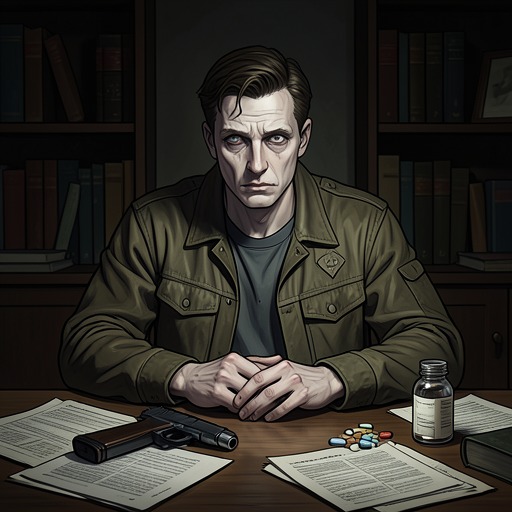
The silence that follows marks a break in that momentum. Peter collapses and turns the gun toward his own heart, prepared to surrender to the cold. He thinks the pain will not last long, but his body will not obey: he cannot raise his hand high enough. The guitars fall silent, and the scene shifts from his imagined control over death to his physical inability to carry out the act. When tears come, sobbing itself causes burning pain. The man who had just imagined delivering a final sentence to others cannot complete the sentence against himself.
The child in the kitchen
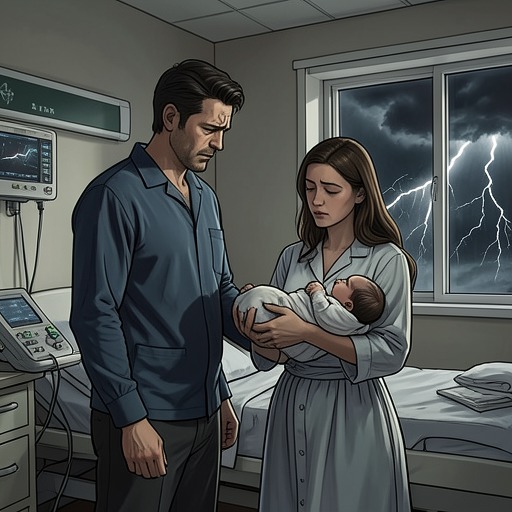
Peter’s attention changes when he notices a child tucked into the corner of the kitchen, hidden beneath the counter. The child grips a stuffed rabbit and is crying hard. This is a concrete, immediate presence inside the wreckage Peter has made; the scene gives him no time to recast the violence as an abstraction or to imagine that its consequences end with the dead.
The child’s presence brings recognition. Peter understands what he has done and imagines that he will always have to see the child’s eyes. He recasts survival as a sentence: he will stay alive for the child and atone. The resolve is expressed not as a plan for repairing what happened, but as a commitment to remain and bear its consequences. His body still limits what he can do. He tries to reach toward the child and then to retrieve his mobile phone from his jacket, but the pain is overwhelming.
Peter whispers an apology. The child stops crying, puts a pacifier into their mouth, and stares at him with wide, frightened blue eyes. The brief quiet does not amount to forgiveness or reconciliation; the child remains visibly terrified, and Peter’s words cannot reverse the scene. The contrast between the small gestures of the child and the bodies around Peter makes the decision to live both intimate and inescapably bound to the harm he has caused.
Survival as obligation
Peter’s turn away from suicide is not a triumphant recovery. The earlier image of himself as ice and stone gives way to tears, pain, and the recognition of another person’s vulnerability. His stated reason for living is the child, but the reason is inseparable from atonement: he does not imagine survival as escape from punishment. He believes that living, and carrying the child’s frightened gaze with him, is itself the punishment he must accept.
The scene nevertheless leaves his physical fate unresolved. After making that decision, Peter slips away into the icy cold. His intention to live is clear, but the passage does not confirm that he recovers or show what atonement will require. That uncertainty preserves the difference between a moral choice and its outcome: Peter has chosen a reason to continue, yet his injured, failing body may not allow him to act on it. The closing desire he has carried throughout the story—to be held from time to time—echoes against this moment, when he is left with pain, an apology, and the child’s frightened stare.